The BGJWSC was the victim of fraudulent financial transactions between May and June of 2016. During that time, $40,986.96 in unauthorized transactions was charged to us via counterfeit checks and ACH payments. Our banking services provider, BB&T, assumed responsibility for covering all charges as a benefit of our contract with them and the BGJWSC was not held responsible for any of the loss.
This fraud was perpetrated by using the routing number and account number from one of our authorized checks intercepted by persons of interest. Any payment made by check is potentially exposing you to the same risk.
How were we made aware of the fraud?
BB&T Bank notified the BGJWSC Finance Division staff regarding a suspicious duplicate check number at the end of May, 2016.
How quickly did the BGJWSC react?
Our staff immediately responded by researching all recent payments to determine validity of the transactions.
How many paper checks were forged?
Three fraudulent paper checks were presented for payment and accepted by the bank. These charges were applied to our account but reversed by July, 2016.
How many ACH transactions occurred?
Thirteen ACH transactions were created. These charges were applied to our account but reversed by July, 2016.
There were more attempts made beyond this amount which were rejected by the bank automatically.
What indications are there that this fraud has crossed state lines and involved the FBI?
As the matter is under local investigation, we are unaware of FBI involvement and cannot comment.
Has the suspect been identified and the funds accounted for?
The BGJWSC has been informed that, as the case is ongoing and the BGJWSC has no further stake in the matter, reconciling the lost funds will be coordinated between investigators and BB&T Bank.
Were we adversely affected in any way, whether short or long term?
This happened so quickly that every bona fide payment sent was honored and no fees were assessed to the BGJWSC. Every recipient expecting an authorized check from us received the funds as they expected to.
What safeguards are now in place to prevent the fraud in the future?
As of June, 2016 when the fraud was identified, we activated an arrangement with our banking services provider, BB&T, which involves reporting the payee, amount and check number of all checks issued. We receive notification from the bank on any transaction that is unauthorized, giving us the opportunity to approve or reject suspicious transactions.
To protect the integrity of the ongoing investigation, any other details regarding the persons of interest and recovery of the funds is being communicated between the City of Brunswick Criminal Investigation Division and BB&T Bank and cannot be discussed.
Effective immediately, as of 7:20 PM on Thursday, March 16, 2017, all required microbiological testing of water samples from the area affected by the boil water advisory issued for the Rosewood Drive and Gatch Lane in Brunswick on March 15, 2017 has passed. Results have been verified by our state-licensed technician within a certified laboratory environment.
This notification is an ALL-CLEAR and water used for drinking will no longer need to be boiled.
Though the water from this system can now be considered to meet safe drinking water standards, please discard any ice made within the last 48 hours.
The details below outline the project referred to as PS2032, which is located in the area between North Harrington Road and Palmetto Street on Frederica Road, on the northern half of St Simons Island. This wastewater force main basin serves approximately 3,400 customers north of and including Sea Palms West. This improvement is required in order to continue serving this existing customer base and also prepare the way for future growth.
Construction has begun. Routine updates to this briefing will be posted every two weeks following a planning meeting with BGJWSC, Glynn County and contract construction personnel. The first onsite planning meeting occurred Tuesday, January 17, 2017. Following future meetings, progress will be reported in advance to the next phase of construction.
Update 5
Horizontal directional drilling (HDD) is complete for Frederica Rd and Palmetto St. Drill rig equipment will be demobilized by the end of the day on Friday, March 17.
Tie-ins at each HDD segment (3 to 4 days each) required with small open cut areas to make tie-ins starting with the following:
North side of right-of-way on Palmetto St between 3rd and 4th Ave. – Palmetto St to remain open with limited encroachment to roadway.
East side of Frederica Rd right-of-way across from Palmetto Court. – Temporary bike/pedestrian path installed with bike/pedestrian detour signs as necessary.
East side of Frederica Rd right-of-way, south of Palm Drive. – Temporary bike/pedestrian path installed with bike/pedestrian detour signs as necessary.
East side of Frederica Rd right-of-way, across from St. Clair Parkway. – Temporary bike/pedestrian path installed with bike/pedestrian detour signs as necessary.
A copy of both the map image and this report are available as an Adobe Acrobat PDF below:
A loss of pressure in the distribution system may cause back-pressure, back-siphonage, or a net movement of water from outside the pipe to the inside through cracks, breaks, or joints in the distribution system that are common in all water systems. Such a system failure carries with it a potential that bacterial contamination or other disease-causing organisms could enter the water distribution system. These conditions may pose an imminent and substantial health endangerment to persons served by the water system.
A precautionary boil water advisory is being published as a warning to those who live in, work in, or travel through the affected area. During the period of the loss of pressure, water will also not be available for fire suppression use.
We take every measure that we can to ensure that your water is safe to drink. You can normally expect your water to flow to your house at around 60 pounds per square inch (PSI). This pressure, coupled with a small amount of chlorine that’s added at the water plant, helps insure that no harmful bacteria gets a chance to grow. A boil water advisory is a precautionary notice sent out to alert customers that a main break has caused system pressure to drop below 20 PSI. Due to this drop in pressure, bacteria may get a chance to breed and spread through the pipes. The chances of this happening may be slim, depending on how quickly we are able to restore service, but we are still going to alert you to this situation out of an abundance of caution. Until an all-clear notice is given, boiling water intended for direct consumption for at least three minutes is advised.
What Can We Do To Prevent Them?
The most important thing that anyone can do to prevent a boil water advisory is to call 811 before you dig. Some main breaks are caused by unauthorized excavating in the area of our utilities. Other main breaks are the result of natural causes or failures in material. However, making the free call to the Georgia Utilities Protection Center helps reduce the risk of hitting our mains, power lines, communications lines or gas lines as each utility will provide either a paint marking or flag indicator of the services located underground, as depicted here:
Why Are They Becoming More Frequent?
The precautionary boil water advisory process has been in United States Environmental Protection Agency (EPA) and the Georgia Department of Natural Resources Environmental Protection Division (EPD) guidelines for many years. Prior to Hurricane Matthew in October 2016, the BGJWSC did not follow the guidelines as a policy and there was no statutory enforcement of the notifications by either the EPA or EPD.
During the Hurricane Matthew response efforts, we put out a boil water advisory for the St. Simons Island district due to a major and significant service outage caused by a main break. That advisory was prompted by the recommendation of an agent of the Georgia Emergency Management and Homeland Security Agency (GEMHSA) embedded in the Glynn County Public Safety Complex (911 Center) at the time and was considered the right thing to do considering the large number of affected customers. We have subsequently made the decision that the right thing then is still the right thing now and into the future.
How Will I Be Notified?
We will now issue these warnings following the EPA and EPD guidance: a drop of pressure below 20 PSI for any length of time will warrant distributing a boil water advisory to the affected citizens using the most effective means available to us. Our staff will then test water samples for bacterial growth for 24 to 48 hours. Once the testing has completed without an indication of harmful bacterial growth, we will issue the all-clear.
We are presently sending that notice out from our website, to radio and print media, social media, and to those that have subscribed to our website to receive these and other regular updates. We’re pursuing more active methods to deliver the notice, such as via text or phone, but will, at the least, continue to use the existing methods, which has been approved as a ‘best practice’ by the EPD.
Please subscribe to our website to receive emails from us or follow our Facebook and Twitter pages as well to ensure that you are getting the fastest, most accurate information delivery regarding the services that we provide to you.
Why Do Restaurants Have to Close Down?
Periodically, the Brunswick-Glynn Joint Water & Sewer Commission (BGJWSC) is required to issue boil water advisories that may affect the water service provided to food service establishments. Glynn County Environmental Health, through Foodservice rule 511-6-1-.03 subsection (2)(n), requires the person in charge of a food service establishment to discontinue operations of the establishment until the boil water advisory is lifted. However, operations may continue if the food service establishment has an approved emergency operations plan on file with Glynn County Environmental Health prior to the occurrence of the event.
The BGJWSC and Glynn County Environmental Health understand that discontinuing operations for 36-48 hours is never the preferred option for the owner of the food service establishment. Please click here to review a brochure outlining what each food service establishment must do to have an approved water interruption plan to prevent having to discontinue operations in the event of a boil water advisory.
For further information on the requirements for a water interruption plan, please contact Wayne Nuenke with Glynn County Environmental Health at 912-279-2941 or wayne.nuenke@dph.ga.gov.
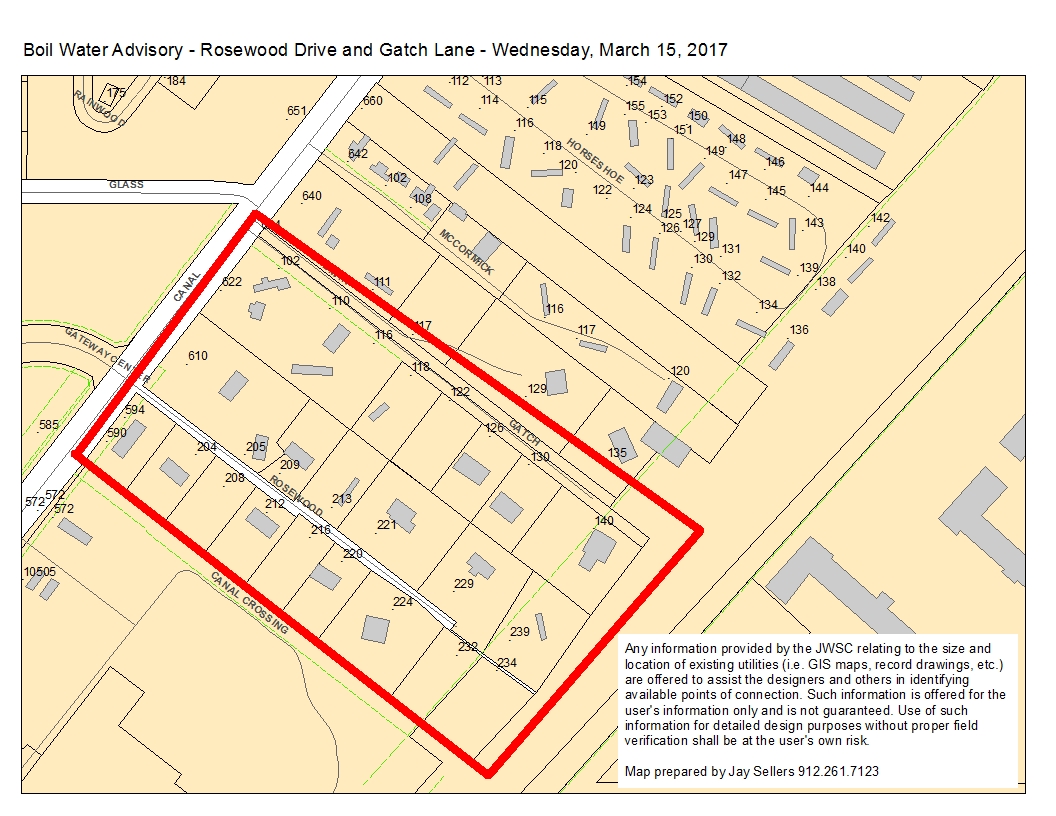
The Brunswick water system will lose pressure in the Rosewood Drive and Gatch Lane streets on Wednesday, March 15, 2017 from 7:30 am to 5:00 pm due to distribution system repairs in the area. This loss of pressure in the distribution system may cause back-pressure, back-siphonage, or a net movement of water from outside the pipe to the inside through cracks, breaks, or joints in the distribution system that are common in all water systems. Such a system failure carries with it a potential that bacterial contamination or other disease-causing organisms could enter the water distribution system. These conditions may pose an imminent and substantial health endangerment to persons served by the water system.
This precautionary boil water advisory is being published as a warning to those that live in, work in, or travel through the affected area. During the period of the loss of pressure, water will also not be available for fire suppression use. The map below indicates the limit to which this precautionary boil water advisory applies:
What should I do?
DO NOT DRINK THE WATER WITHOUT BOILING IT FIRST. Bring all water to a rolling boil for at least (3) three minutes, and let it cool before using, or use bottled water. Boiled or bottled water should be used for drinking, making ice, brushing teeth, washing dishes, and food preparation until further notice. Boiling kills bacteria and other organisms in the water. ALL STORED WATER, DRINK OR ICE MADE RECENTLY FROM THIS SUPPLY SHALL BE DISCARDED.
Bathing, showering and toilet flushing may be performed using water from the tap without boiling it first.
Inadequately treated water may contain disease-causing organisms. These organisms include bacteria, viruses, and parasites which can cause symptoms such as diarrhea, cramps, nausea, headaches, or other symptoms. They may pose a special health risk for infants, young children, some of the elderly and people with severely compromised immune systems.
The symptoms above are not caused only by organisms in drinking water. If you experience any of these symptoms and they persist, you may want to seek medical advice. People at increased risk should seek advice about drinking water from their health care providers.
What is being done?
As soon as pressure can be restored to the distribution system, our water lab personnel will take water samples that will be fully evaluated over the next twenty-four to forty-eight hour period following the repair of the main. Once we have determined that there is no longer a threat of harmful bacteria in the water, we will inform you that you are no longer required to boil your water by posting an update here on our website: http://www.bgjwsc.org.
Effective immediately, as of 5:01 PM on Saturday, March 11, 2017, all required microbiological testing of water samples from the area affected by the boil water advisory issued for the 2100 block of Union Street in Brunswick on March 10, 2017 has passed. Results have been verified by our state-licensed technician within a certified laboratory environment.
This notification is an ALL-CLEAR and water used for drinking will no longer need to be boiled.
Though the water from this system can now be considered to meet safe drinking water standards, please discard any ice made within the last 48 hours.
The Brunswick water system lost pressure in the 2100 block of Union Street, from K Street to L Street, due to distribution system damages caused by unauthorized digging in the area. This loss of pressure in the distribution system may cause back-pressure, back-siphonage, or a net movement of water from outside the pipe to the inside through cracks, breaks, or joints in the distribution system that are common in all water systems. Such a system failure carries with it a potential that bacterial contamination or other disease-causing organisms could enter the water distribution system. These conditions may pose an imminent and substantial health endangerment to persons served by the water system.
What should I do?
DO NOT DRINK THE WATER WITHOUT BOILING IT FIRST. Bring all water to a rolling boil for at least (3) three minutes, and let it cool before using, or use bottled water. Boiled or bottled water should be used for drinking, making ice, brushing teeth, washing dishes, and food preparation until further notice. Boiling kills bacteria and other organisms in the water. ALL STORED WATER, DRINK OR ICE MADE RECENTLY FROM THIS SUPPLY SHALL BE DISCARDED.
Bathing, showering and toilet flushing may be performed using water from the tap without boiling it first.
Inadequately treated water may contain disease-causing organisms. These organisms include bacteria, viruses, and parasites which can cause symptoms such as diarrhea, cramps, nausea, headaches, or other symptoms. They may pose a special health risk for infants, young children, some of the elderly and people with severely compromised immune systems.
The symptoms above are not caused only by organisms in drinking water. If you experience any of these symptoms and they persist, you may want to seek medical advice. People at increased risk should seek advice about drinking water from their health care providers.
What happened? What is being done?
As soon as pressure can be restored to the distribution system, our water lab personnel will take water samples that will be fully evaluated over the next twenty-four to forty-eight hour period following the repair of the main. Once we have determined that there is no longer a threat of harmful bacteria in the water, we will inform you that you are no longer required to boil your water by posting an update here on our website: http://www.bgjwsc.org.