Author: jsellers

All-Clear for Boil Water Advisory Issued for the 5000 Block of Altama Ave and Bristol Drive in Brunswick on 5/11/17

Effective immediately, as of 9:20 AM on Saturday, May 13, 2017, all required microbiological testing of water samples from the area affected by the boil water advisory issued for the 5000 block of Altama Avenue and Bristol Drive in Brunswick on May 11, 2017 has passed. Results have been verified by our state-licensed technician within a certified laboratory environment.

This notification is an ALL-CLEAR and water used for drinking will no longer need to be boiled.

Though the water from this system can now be considered to meet safe drinking water standards, please discard any ice made within the last 48 hours.

What is a Boil Water Advisory? READ MORE HERE

Sewer Capacity Availability Update 1

BGJWSC sanitary sewer systems are in need of updating in order to accommodate existing demand as well as future growth. Maps will be provided as a visual to aid understanding of that need.

Update 1

As an introduction, this update will be the first detailed mention that many of you will have seen to help you understand the circumstances that brought us to the point of instituting restrictions on new sewer connections in some areas last year. It will also help you gain an understanding as to why our rating structure is under review.

Please review the maps below and the details underneath these maps to get a better understanding of the situation:
Sewer_Capacity_Availability_-_Update_1_-_May_12,_2017_-_Mainland_Basin_Map
Sewer_Capacity_Availability_-_Update_1_-_May_12,_2017_-_North_Mainland_Basin_Map
Sewer_Capacity_Availability_-_Update_1_-_May_12,_2017_-_South_Mainland_Basin_Map
Sewer_Capacity_Availability_-_Update_1_-_May_12,_2017_-_Saint_Simons_Basin_Map

The information below will remain unchanged for each update:

What

In our ongoing efforts to make clear, easy to understand visuals, the staff of the Planning & Construction Division and the Systems Pumping & Maintenance Division have developed a mapping project to outline the timeline of sewer service capacity availability across our three systems. The maps above are not meant to be a guarantee of capacity as of a particular date since engineering and construction is ongoing and dynamic. As new connections and system improvements are made, this information and the maps visualizing the updates will be made available following Commission discussion once or twice per month, or as often as requested by the Commission. When upgrades have been performed by our in-house construction team or utility contractors, that progress will be shown, as well.

Where

The BGJWSC maintains three distinct and separate sanitary sewer utility systems: Mainland Brunswick, South Mainland and St. Simons Island, each flowing into it’s own treatment plant. Work on the conveyance to these plants will be prioritized by demand, with regional stations serving the greatest number of customers being of greatest priority. System improvements will be made to satisfy current demand. System expansion will be fueled and, in many cases, funded by developers.  Our new Unsolicited Proposal Policy outlines the methodology that will allow development in basins not having adequate capacity by giving developers the means to make the necessary upgrades that will provide for the desired residential equivalent units (REU). As the BGJWSC is neutral in terms of development but water and sewer service is a vital component of the community’s economic and environmental health, we are anxious to be able to serve customers wherever they choose to dwell.

When

This is an ongoing project that will follow the path of the 2016 Master Plan Update.

Why

As identified in the 2016 Master Plan Update, system health was poor, at best, in some areas. The system was not allowed to grow sufficiently to accommodate the demand. All sewer basins have since come under staff and independent engineering review to access these assets through the lens of satisfying existing needs while also preparing for sustainable growth in light of community development efforts with our partners in Glynn County and City of Brunswick governments.

Who

Contact for this project is:

Todd Kline, PE, Senior Engineer,
Planning & Construction Division
Brunswick-Glynn County
Joint Water & Sewer Commission
1703 Gloucester St
Brunswick, GA 31520
Office: 912.261.7126
tkline@bgjwsc.org

Regular project updates will be available on BGJWSC’s website: http://www.bgjwsc.org/
All-Clear for Boil Water Advisory Issued for Glynn Pines Apartments in Brunswick on 5/10/17

Effective immediately, as of 11:18 AM on Friday, May 12, 2017, all required microbiological testing of water samples from the area affected by the boil water advisory issued for Glynn Pines Apartments in Brunswick on May 10, 2017 has passed. Results have been verified by our state-licensed technician within a certified laboratory environment.

This notification is an ALL-CLEAR and water used for drinking will no longer need to be boiled.

Though the water from this system can now be considered to meet safe drinking water standards, please discard any ice made within the last 48 hours.

What is a Boil Water Advisory? READ MORE HERE

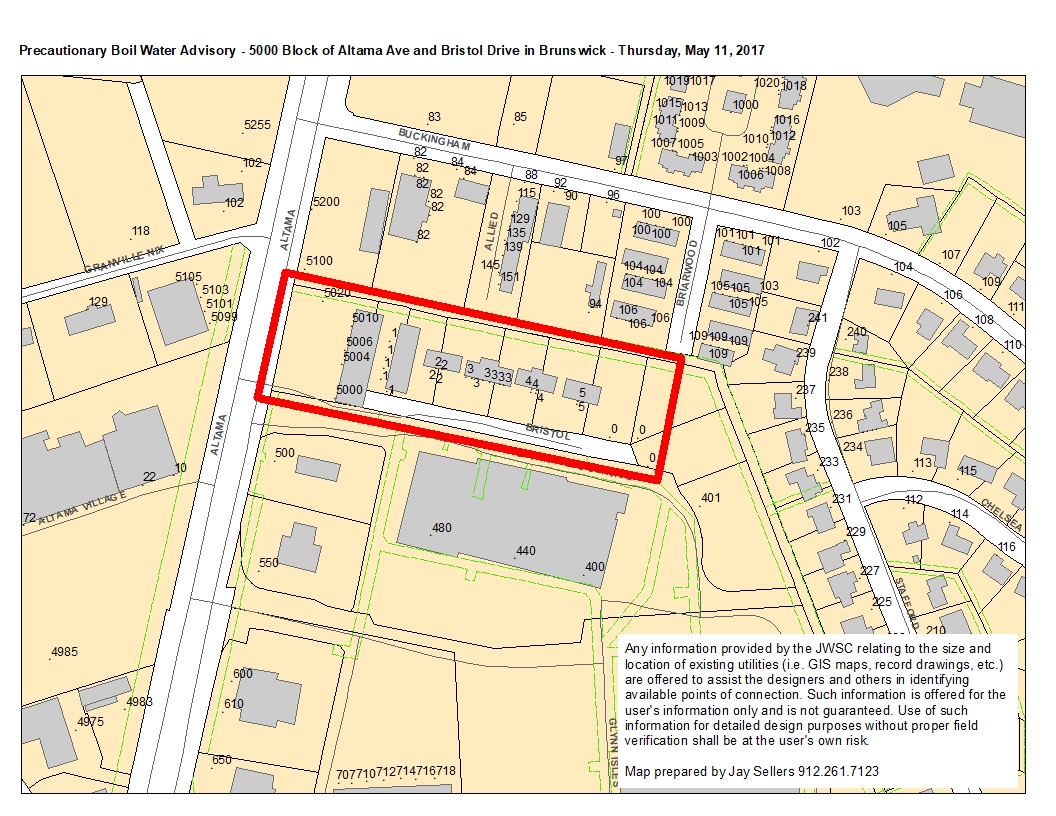
Precautionary Boil Water Advisory – 5000 Block of Altama Ave and Bristol Ave in Brunswick – Thursday, May 11, 2017

DRINKING WATER WARNING

BOIL YOUR WATER FOR THREE MINUTES BEFORE USING

The Brunswick water system has lost pressure in the area serving the 5000 block of Altama Ave and all of Bristol Ave on Thursday, May 11, 2017 due to pine tree roots growing into the main causing fractures.

This loss of pressure in the distribution system may cause back-pressure, back-siphonage, or a net movement of water from outside the pipe to the inside through cracks, breaks, or joints in the distribution system that are common in all water systems. Such a system failure carries with it a potential that bacterial contamination or other disease-causing organisms could enter the water distribution system. These conditions may pose an imminent and substantial health endangerment to persons served by the water system.

This precautionary boil water advisory is being published as a warning to those that live in, work in, or travel through the affected area. During the period of the loss of pressure, water will also not be available for fire suppression use. The map below indicates the limit to which this precautionary boil water advisory applies:

What should I do?

  • DO NOT DRINK THE WATER WITHOUT BOILING IT FIRST. Bring all water to a rolling boil for at least (3) three minutes, and let it cool before using, or use bottled water. Boiled or bottled water should be used for drinking, making ice, brushing teeth, washing dishes, and food preparation until further notice. Boiling kills bacteria and other organisms in the water. ALL STORED WATER, DRINK OR ICE MADE RECENTLY FROM THIS SUPPLY SHALL BE DISCARDED.
  • Bathing, showering and toilet flushing may be performed using water from the tap without boiling it first.
  • Inadequately treated water may contain disease-causing organisms. These organisms include bacteria, viruses, and parasites which can cause symptoms such as diarrhea, cramps, nausea, headaches, or other symptoms. They may pose a special health risk for infants, young children, some of the elderly and people with severely compromised immune systems.
  • The symptoms above are not caused only by organisms in drinking water. If you experience any of these symptoms and they persist, you may want to seek medical advice. People at increased risk should seek advice about drinking water from their health care providers.

What is being done?

As soon as pressure can be restored to the distribution system, our water lab personnel will take water samples that will be fully evaluated over the next twenty-four to forty-eight hour period following the repair of the main. Once we have determined that there is no longer a threat of harmful bacteria in the water, we will inform you that you are no longer required to boil your water by posting an update here on our website: http://www.bgjwsc.org.

Water System ID#: 1270001

Date distributed: 5/11/17 12:14 PM

What is a Boil Water Advisory? READ MORE HERE

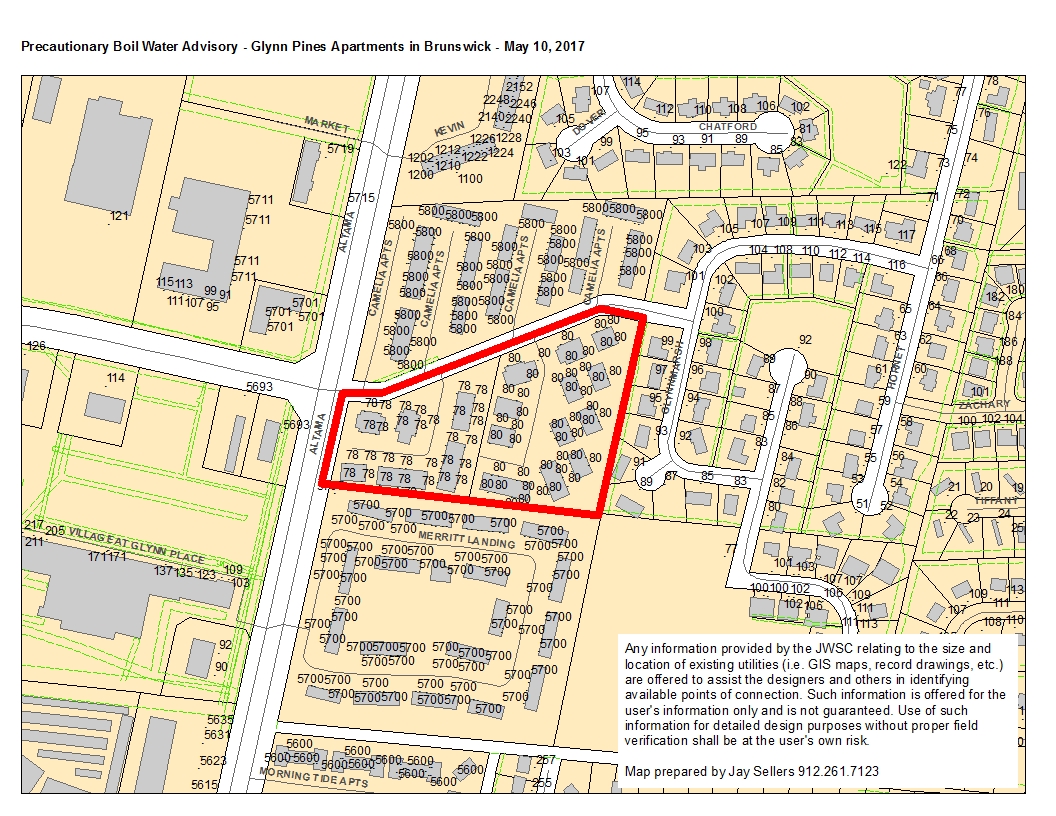
Precautionary Boil Water Advisory – Glynn Pines Apartments in Brunswick – Wednesday, May 10, 2017

DRINKING WATER WARNING

BOIL YOUR WATER FOR THREE MINUTES BEFORE USING

The Brunswick water system has lost pressure in the area serving Glynn Pines Apartments on Wednesday, May 10, 2017 due to a broken service connection in the private water system serving a residential unit in the apartment area. Water to the entire complex must be turned off to enable a plumbing contractor to repair the break.

This loss of pressure in the distribution system may cause back-pressure, back-siphonage, or a net movement of water from outside the pipe to the inside through cracks, breaks, or joints in the distribution system that are common in all water systems. Such a system failure carries with it a potential that bacterial contamination or other disease-causing organisms could enter the water distribution system. These conditions may pose an imminent and substantial health endangerment to persons served by the water system.

This precautionary boil water advisory is being published as a warning to those that live in, work in, or travel through the affected area. During the period of the loss of pressure, water will also not be available for fire suppression use. The map below indicates the limit to which this precautionary boil water advisory applies:

What should I do?

  • DO NOT DRINK THE WATER WITHOUT BOILING IT FIRST. Bring all water to a rolling boil for at least (3) three minutes, and let it cool before using, or use bottled water. Boiled or bottled water should be used for drinking, making ice, brushing teeth, washing dishes, and food preparation until further notice. Boiling kills bacteria and other organisms in the water. ALL STORED WATER, DRINK OR ICE MADE RECENTLY FROM THIS SUPPLY SHALL BE DISCARDED.
  • Bathing, showering and toilet flushing may be performed using water from the tap without boiling it first.
  • Inadequately treated water may contain disease-causing organisms. These organisms include bacteria, viruses, and parasites which can cause symptoms such as diarrhea, cramps, nausea, headaches, or other symptoms. They may pose a special health risk for infants, young children, some of the elderly and people with severely compromised immune systems.
  • The symptoms above are not caused only by organisms in drinking water. If you experience any of these symptoms and they persist, you may want to seek medical advice. People at increased risk should seek advice about drinking water from their health care providers.

What is being done?

As soon as pressure can be restored to the distribution system, our water lab personnel will take water samples that will be fully evaluated over the next twenty-four to forty-eight hour period following the repair of the main. Once we have determined that there is no longer a threat of harmful bacteria in the water, we will inform you that you are no longer required to boil your water by posting an update here on our website: http://www.bgjwsc.org.

Water System ID#: 1270001

Date distributed: 5/10/17 6:15 PM

What is a Boil Water Advisory? READ MORE HERE