Effective immediately, as of 4:27 PM on Tuesday, June 27, 2017, all required microbiological testing of water samples from the area affected by the boil water advisory issued for the Island Square Apartments and Island Retreat Condos on June 26, 2017 has passed. Results have been verified by our state-licensed technician within a certified laboratory environment.
This notification is an ALL-CLEAR and water used for drinking will no longer need to be boiled.
Though the water from this system can now be considered to meet safe drinking water standards, please discard any ice made within the last 48 hours.
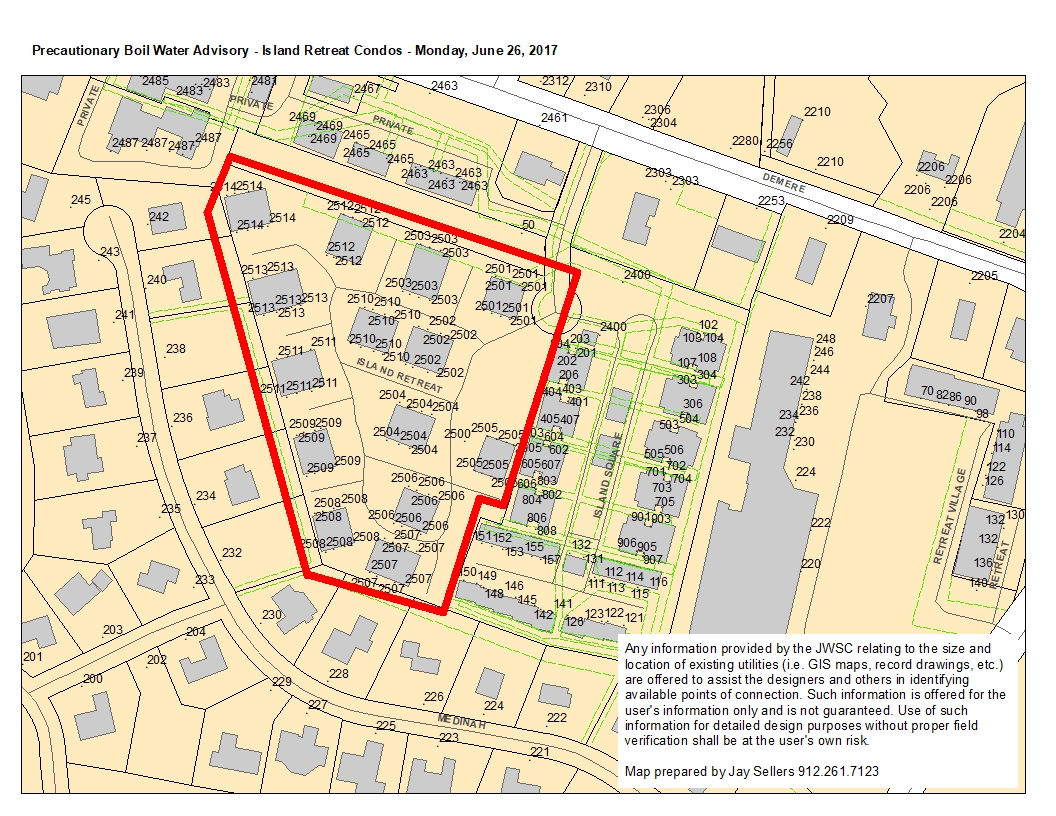
The St. Simons Island water system has lost pressure in the area serving Island Retreat Condos off Demere Road on St. Simons Island on Monday, June 26, 2017 due to a leaking service main within the private property area. A private contractor will be working to make the repairs within the development today.
This loss of pressure in the distribution system may cause back-pressure, back-siphonage, or a net movement of water from outside the pipe to the inside through cracks, breaks, or joints in the distribution system that are common in all water systems. Such a system failure carries with it a potential that bacterial contamination or other disease-causing organisms could enter the water distribution system. These conditions may pose an imminent and substantial health endangerment to persons served by the water system.
This precautionary boil water advisory is being published as a warning to those that live in, work in, or travel through the affected area. During the period of the loss of pressure, water will also not be available for fire suppression use. The map below indicates the limit to which this precautionary boil water advisory applies:
What should I do?
DO NOT DRINK THE WATER WITHOUT BOILING IT FIRST. Bring all water to a rolling boil for at least (3) three minutes, and let it cool before using, or use bottled water. Boiled or bottled water should be used for drinking, making ice, brushing teeth, washing dishes, and food preparation until further notice. Boiling kills bacteria and other organisms in the water. ALL STORED WATER, DRINK OR ICE MADE RECENTLY FROM THIS SUPPLY SHALL BE DISCARDED.
Bathing, showering and toilet flushing may be performed using water from the tap without boiling it first.
Inadequately treated water may contain disease-causing organisms. These organisms include bacteria, viruses, and parasites which can cause symptoms such as diarrhea, cramps, nausea, headaches, or other symptoms. They may pose a special health risk for infants, young children, some of the elderly and people with severely compromised immune systems.
The symptoms above are not caused only by organisms in drinking water. If you experience any of these symptoms and they persist, you may want to seek medical advice. People at increased risk should seek advice about drinking water from their health care providers.
What is being done?
As soon as pressure can be restored to the distribution system, our water lab personnel will take water samples that will be fully evaluated over the next twenty-four to forty-eight hour period following the repair of the main. Once we have determined that there is no longer a threat of harmful bacteria in the water, we will inform you that you are no longer required to boil your water by posting an update here on our website: http://www.bgjwsc.org.
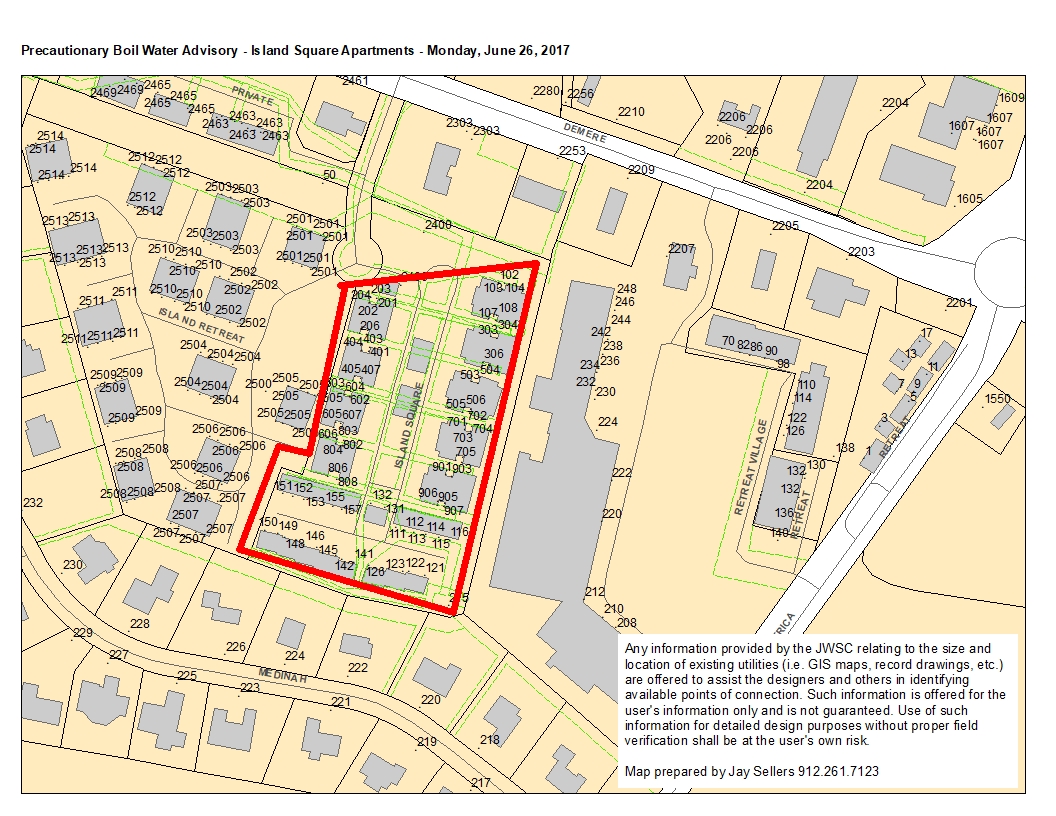
The St. Simons Island water system has lost pressure in the area serving Island Square Apartments off Demere Road on St. Simons Island on Monday, June 26, 2017 due to a leaking service main within the private property area. A private contractor will be working to make the repairs within the development today.
This loss of pressure in the distribution system may cause back-pressure, back-siphonage, or a net movement of water from outside the pipe to the inside through cracks, breaks, or joints in the distribution system that are common in all water systems. Such a system failure carries with it a potential that bacterial contamination or other disease-causing organisms could enter the water distribution system. These conditions may pose an imminent and substantial health endangerment to persons served by the water system.
This precautionary boil water advisory is being published as a warning to those that live in, work in, or travel through the affected area. During the period of the loss of pressure, water will also not be available for fire suppression use. The map below indicates the limit to which this precautionary boil water advisory applies:
What should I do?
DO NOT DRINK THE WATER WITHOUT BOILING IT FIRST. Bring all water to a rolling boil for at least (3) three minutes, and let it cool before using, or use bottled water. Boiled or bottled water should be used for drinking, making ice, brushing teeth, washing dishes, and food preparation until further notice. Boiling kills bacteria and other organisms in the water. ALL STORED WATER, DRINK OR ICE MADE RECENTLY FROM THIS SUPPLY SHALL BE DISCARDED.
Bathing, showering and toilet flushing may be performed using water from the tap without boiling it first.
Inadequately treated water may contain disease-causing organisms. These organisms include bacteria, viruses, and parasites which can cause symptoms such as diarrhea, cramps, nausea, headaches, or other symptoms. They may pose a special health risk for infants, young children, some of the elderly and people with severely compromised immune systems.
The symptoms above are not caused only by organisms in drinking water. If you experience any of these symptoms and they persist, you may want to seek medical advice. People at increased risk should seek advice about drinking water from their health care providers.
What is being done?
As soon as pressure can be restored to the distribution system, our water lab personnel will take water samples that will be fully evaluated over the next twenty-four to forty-eight hour period following the repair of the main. Once we have determined that there is no longer a threat of harmful bacteria in the water, we will inform you that you are no longer required to boil your water by posting an update here on our website: http://www.bgjwsc.org.
The Brunswick-Glynn Joint Water & Sewer Compliance & Legislative Committee has approved the release of one new/revised industrial draft permit for public review and comment. This permit has been drafted pursuant to the Code of Federal Regulations, 40 CFR Part 403, the Glynn County Water Use Ordinance, Article III & the City of Brunswick Water Use Ordinance, Article III. The industrial pretreatment permits outline the steps the industries will follow in treating and monitoring their wastewater discharge as well as the steps Brunswick-Glynn Joint Water & Sewer Commission will follow in enforcing the regulations on permitted Industrial Users to the Sewage Treatment Plants.
A copy of this industrial pretreatment permit is available to be viewed by the public at the main office of the Brunswick-Glynn Joint Water & Sewer Commission, 1703 Gloucester Street, Brunswick, GA 31520. This permit will be available for public review and comment between the hours of 9 AM and 3 PM, Monday through Friday, until July 21, 2017. Any citizen interested in reviewing the draft industrial pretreatment permit and/or commenting on it may contact Angela Walker, Pretreatment Compliance Coordinator at Academy Creek Wastewater Department at 912-261-7143 to arrange a time for reviewing the permit or visit the main office and ask to view it.
The BGJWSC has begun using a Public Emergency Notification System for immediate mass communications of emergency information.
Effective at 8:00 am on Thursday, June 22, 2017, all boil water advisory alerts, unexpected road closures and unplanned service outages will be communicated to subscribers using this emergency notification system. This system, produced by Everbridge, Inc., will allow the public to set up multiple means of communication, including text, land-line phone message, cell phone message and email. If we fail to reach you using one method, the system will automatically roll over to the next method until you confirm receipt of the message. A brief introduction of this system is available in the orientation video below:
Existing customers that have provided an email address will receive an email to confirm their preferences for the service once their data has been put into the system. However, please feel free to register now, if you wish, as this data migration may take some time.
Those of you that have previously received emergency notifications via email from our online subscription service will find that system will be phased out by the end of August, 2017 at which time all emergency notifications will be sent out via this Public Emergency Notification System. All non-emergency notifications will continue to be sent via the website email system, as outlined on the Subscribe to Updates page on our website.
I’m standing by to assist if you have any questions on how to make the transition or if you have questions about how to register for the new Public Emergency Notification System.
For your consideration, please review the agenda for the Special Called Meeting scheduled for Thursday, June 29, 2017 at 2:00 pm in the Commission Meeting Room.
For your consideration please review the agenda for the Public Information & Customer Relations Committee Meeting scheduled for Tuesday, June 27, 2017 at 2:00 pm.